

Advanced Practice Providers (APPs) play a pivotal role in healthcare in the United States, from diagnosing and treating patients to conducting research and continuing their education. APPs make up about 41% of the healthcare workforce in the following roles: Nurse Practitioners (NPs), Certified Registered Nurse Anesthetists (CRNAs), Certified Nurse Midwives (CNMs), and Physician Assistants (PAs).
In this blog, we will discuss each specialty, 2026 advanced practice provider employment trends, and how APPs continue to revolutionize healthcare.
What is an Advanced Practice Provider (APP)?

An Advanced Practice Provider is a healthcare professional who has undergone advanced training in a particular field and is licensed to diagnose, treat, and care for patients.
NPs, CRNAs, CNMs, and PAs are all considered APPs.
Each type of APP has their own education and licensing requirements:
A Nurse Practitioner is a registered nurse who has obtained a master’s or doctoral degree and can, depending on the state in which they practice, prescribe controlled substances and order lab tests for their patients.
All NPs focus on a specific patient population and/or specific areas of nursing such as family (FNPs), pediatric (PNPs), and adult-gerontology (AGNPs).
Nurse Practitioner Employment Trends
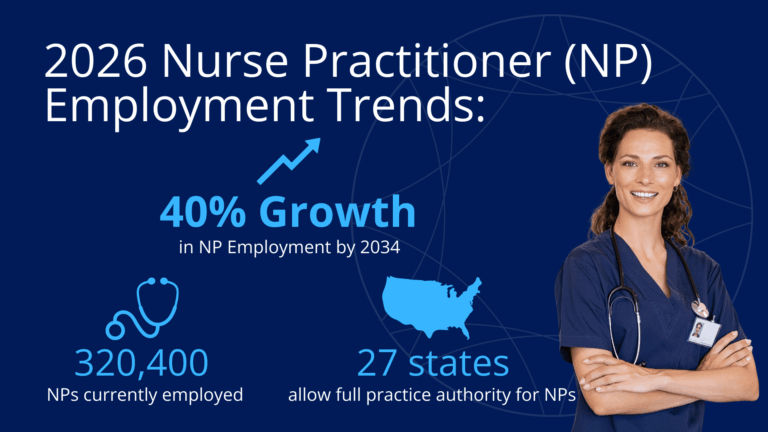
There are currently 320,400 NPs working in the United States. It is estimated that NPs will experience an explosive 40% growth in employment by 2034, particularly in surgical and primary care settings.
The scope of practice NPs work within depends on the state in which they practice. There are currently 27 states that give NPs full practice authority. This means that Nurse Practitioners can write prescriptions for their patients, order lab tests, diagnose conditions, and otherwise practice independently of a supervising physician.
12 states allow reduced practice, which means that certain duties are restricted. The last 11 states required NPs to be supervised by a physician.
What is a Physician Assistant (PA)?
A Physician Assistant (or Physician Associate) is a licensed healthcare provider who practices medicine in various specialties and settings, such as family medicine or surgery.
Physician Assistants can write prescriptions for patients, diagnose conditions, manage treatment plans, and order tests.
Physician Assistant Employment Trends
There are about 162,400 Physician Assistants currently employed. It is projected that the profession will see 20% employment growth over the next decade.
Like NPs, the level of independence PAs have depends on the state where they work. There are currently only seven states that allow PAs to practice to the full extent of their profession. All other states limit their scope of practice in some capacity.
CRNA and CNM Employment Trends
What are Certified Registered Nurse Anesthetists (CRNAs)?
Certified Registered Nurse Anesthetists (CRNAs) are advanced practice RNs who administer anesthesia to patients in various settings, like hospitals and ambulatory surgery centers, and monitor and help manage pain symptoms.
There are currently 53,800 CRNAs employed in the United States. It is expected that employment will increase by 9% by 2034.
Like NPs and PAs, CRNAs are becoming more independent in healthcare, practicing without the need for physician oversight. Many CRNAs are choosing locum tenens as a viable career option and partnering with locum tenens agencies, such as Independence Anesthesia, to support them.
What are Certified Nurse Midwives (CNMs)?
Certified Nurse Midwives are advanced practice RNs who provide women’s healthcare. There are 8,600 CNMs employed today, and the profession is estimated to grow 11% over the next decade.
CNMs have full practice autonomy (and prescriptive authority) in 24 states.
Employment Opportunities for APPs
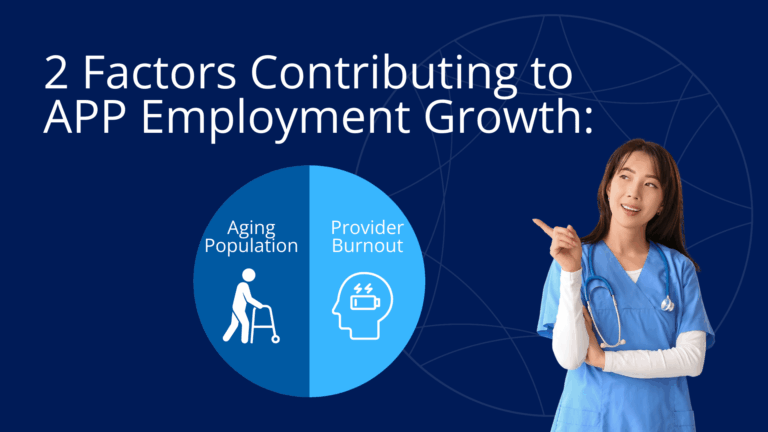
As outlined in this blog, all advanced practice providers will experience significant employment growth over the next ten years, from 9 to 40%. This is due to two factors: an aging population and healthcare provider burnout.
By 2034, the United States is expected to have more citizens aged 65 and older than those aged 18 and younger—the first time in the country’s history. This means that more healthcare providers are required to care for the elderly. Additionally, healthcare providers are also retiring and switching careers at higher rates than in the past (due in part to the COVID-19 pandemic).
Therefore, APPs will become more important than ever as their expertise will be needed to fill employment gaps.
Most In-Demand Care Settings for Advanced Practice Providers
In healthcare, care models are shifting outside of the hospital and into:
- Ambulatory settings
- Hospital-Based Care (Critical Care, Inpatient Services, Managing Complex Patients, Surgical Units and Service Lines)
- Primary & Urgent Care Settings
- Psychiatry, Behavioral Health, Addiction Treatment facilities
- Specialty Medicine settings (Cardiology, Oncology, Neonatology, etc)
- Retail health
Furthermore, APPs are more frequently providing services for elder care, chronic disease management, and home and community settings.
New Opportunities for APP Career Advancement
As we enter 2026, advanced practice providers are stepping into more leadership roles than in the past, with titles such as Lead APP, Chief APP, and Director of Advanced Practice. Not only this, but the following trends are also emerging:
- More leadership and system-level roles
- New program development opportunities
- Expanded scope and autonomy
- Locum tenens as a career option
In addition, new program development opportunities are opening, and APPs are seeking more specialty care and procedural roles.
Advanced Practice Provider Specialties in Highest Demand
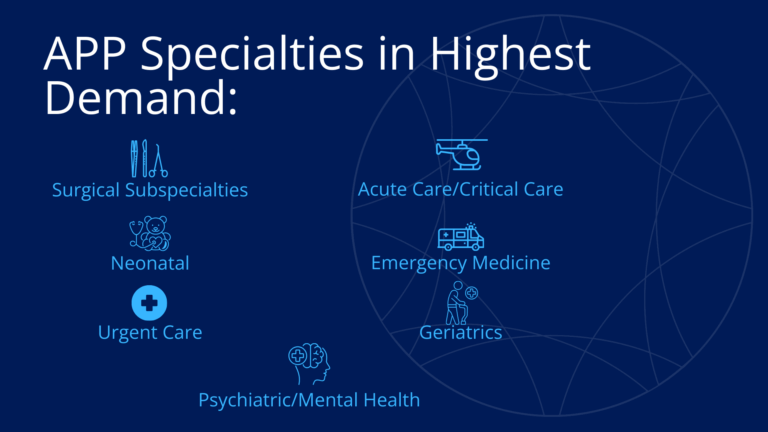
The following APP specialties are experiencing high demand in 2026:
- Surgical subspecialties and procedural roles (General trauma, orthopedic, cardiovascular/cardiothoracic, and neurosurgery are a few examples)
- Acute care, Critical care, ICU, hospital medicine
- Neonatal
- Emergency medicine, urgent care
- Geriatrics, elder care, chronic disease management
- Psychiatric, Mental health
Next Steps for Advanced Practice Providers
As the healthcare shortage grows, it is important to find innovative solutions that enable patients to receive the care they need. Overall, advanced practice providers are becoming more trusted and valued healthcare providers who are assuming more leadership roles. There are more NP and PA specialties and subspecialties than ever before, and the scope of care is expanding as autonomy increases.
As APPs gain more practice authority across the country, employment opportunities across state lines will continue to increase, leading to more flexibility and a better work-life balance.
Partnering with an industry-leading locum tenens agency, like ICON Medical Network, is a smart way to learn of the newest opportunities nationwide while being supported by a dedicated team.
ICON Medical Network has been working with APPs since 2010, providing locum tenens staffing services such as custom job matching, travel coordination and support, weekly pay, licensing assistance, and more.
Contact us today to receive custom tailored support from our team.